Email format finder
Enter a person's name and their company's domain to list the work email addresses they are most likely to have, most common pattern first. Nothing you type leaves your browser, and there's no lookup: the tool builds the candidates from the name and domain, so each one is a guess until you confirm it.
Likely addresses
- Enter a first name, a last name and a company domain to see the likely addresses. This list needs JavaScript.
The percentages are the share of business email addresses that use each pattern across a sample of 336,782, not the odds for this company. A company almost always uses one pattern for everyone, so one confirmed address at the same domain tells you more than any percentage.
Don't send the same email to every candidate. A message to the wrong address is a poor first impression, and addresses that don't exist bounce. Confirm one address first, or use a tool that returns a verified one.
The most common work email formats
In Sendburg's July 2026 analysis of 336,782 business emails, two patterns covered about three in four addresses. The table uses Jordan Lee at company.com.
| Pattern | Example | Share of business emails |
|---|---|---|
| first.last@ | [email protected] | 47.7% |
| flast@ | [email protected] | 26.8% |
| first@ | [email protected] | 8.1% |
| firstlast@ | [email protected] | 2.3% |
| first_last@ | [email protected] | 2.3% |
| f.last@ | [email protected] | 2.1% |
| last@ | [email protected] | 1.2% |
| last.first@ | [email protected] | 0.7% |
| first.l@ | [email protected] | 0.1% |
| first-last@ | [email protected] | 0.1% |
The same study found that about 8.6% of addresses followed none of these patterns: aliases, shared inboxes and custom conventions. It also found that the larger the company, the more predictable the pattern. At companies with 10,000 or more people, 74.2% of addresses were first.last@, against 38.0% at companies of one to ten people, where first@ was about four times as common. That is why the tool moves first@ up the list when you pick a small company. The sample comes from one vendor's contact database, so treat the figures as a guide, not a measurement of every company.
How to confirm which pattern a company uses
- Look for a real address at the same domain. Press releases, conference speaker pages, the "contact" section of a job ad, a recruiter's email signature and published reports often show one. Match its shape to the name.
- Check the job ad. A named contact or a recruiter's address in the posting gives you the pattern for free.
- Use the right domain. Some companies email from a different domain than their website, such as a parent company or a short brand domain. An address on the wrong domain bounces however good the pattern is.
- Spell the name as the company does. Companies use the name on file, which can be a nickname or a shortened form. Jonathan may be jon@.
- Send one message, not several. If the first guess bounces, try the next most likely one, not all of them at once.
Large companies are the easiest to predict and the hardest to check. Many large companies use catch-all domains, which accept mail for any address, so a guess can look delivered without ever reaching anyone. If you are emailing the person who owns a role, our guide to finding a hiring manager's email address covers confirming the right person first, and hiring manager or recruiter helps you choose who to write to.
Get the verified email with Applier Reach
Guessing works when you already know who to write to and have time to confirm the address. Applier Reach is a Chrome extension that starts from the job posting you have open: it finds the people who hire for the role, reveals a work email when one is found, drafts your introduction from your resume and opens it in Gmail. You aren't charged for a reveal unless an email is found, and you get 5 reveals a month free. See how Applier Reach works.
When you have the address, our hiring manager email templates give you an introduction and two follow-ups to adapt.
Real interview invites from members' inboxes
See more interview invites →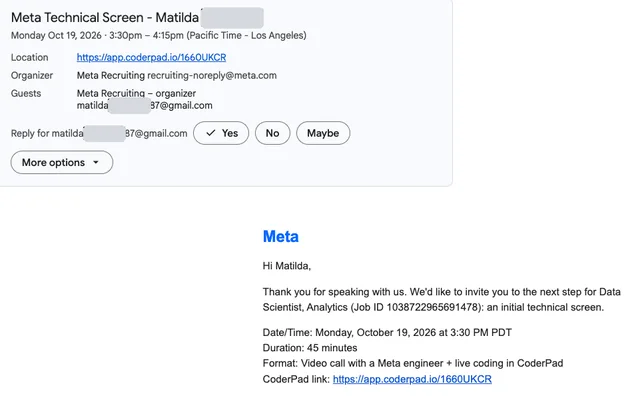
 Meta
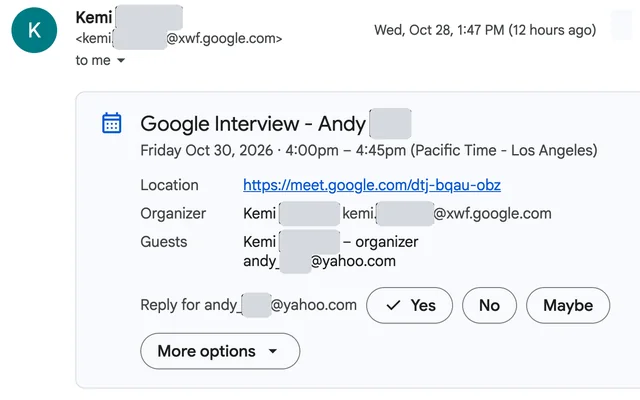
 Google
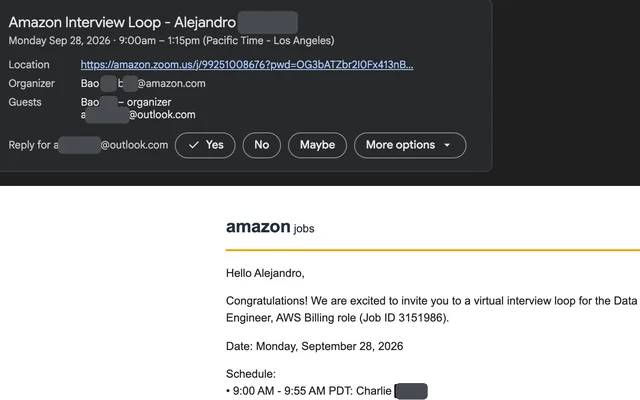
 AWS
Frequently asked questions
What is the most common work email format?
first.last@, such as [email protected]. It made up 47.7% of 336,782 business email addresses in Sendburg's July 2026 analysis, followed by flast@ ([email protected]) at 26.8%. At companies of 10,000 or more people first.last@ reached 74.2%.
Can you find someone's email address from their name and company?
You can list likely addresses by combining the name with the common patterns, but each one is a guess until confirmed. The format finder builds that list in your browser. To get an address that has been looked up for you, use an email lookup tool such as Applier Reach, which starts from the job posting.
Is it OK to send the same email to every guessed address?
No. Wrong guesses bounce, and a message to the wrong address can land with someone else. Confirm one address first, using a real address at the same domain or a verified lookup, or try the next most likely pattern only after the first bounces.